Download the mobile app!
Hooking Up Anglers Since 2011.
Check out our new Android or iOS app for Fishing Status.
The long awaited return of our mobie app is back on Apple App Store and Google Play
Walleye
Species Information
| Scientific Name: | Sander vitreus |
| Common Names: | walleye, yellow pike |
| Environment: | Lake, River, Stream |
| Ideal Temp: | 55-68°F (13-20°C) |
About Walleye
Walleye (Sander vitreus, formerly Stizostedion vitreum) is a freshwater perciform fish native to most of Canada and to the Northern United States. It is a North American close relative of the European pikeperch. The walleye is sometimes called the yellow walleye to distinguish it from the blue walleye, which is a subspecies that can be found in the southern Ontario and Quebec regions.
In some parts of its range, the walleye is known as the walleyed pike, colored pike, yellow pike or pickerel (esp. in English-speaking Canada), although the fish is not related to other species of pikes which are members of the family Esocidae.
Walleyes show a fair amount of variation across watersheds. In general, fish within a watershed are quite similar and are genetically distinct from those of nearby watersheds. The species has been artificially propagated for over a century and has been planted on top of existing populations or introduced into waters naturally devoid of the species, sometimes reducing the overall genetic distinctiveness of populations.
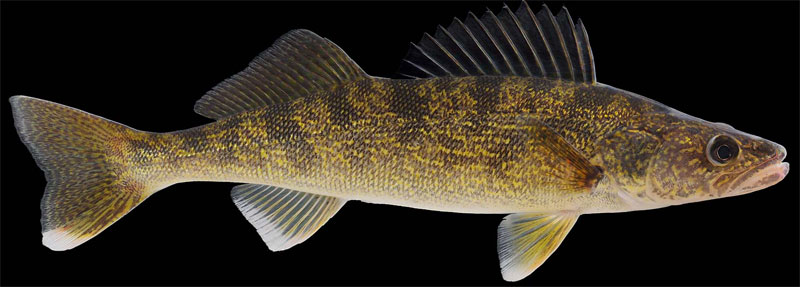
Walleyes are largely olive and gold in colour (hence the French common name: doré — golden). The dorsal side of a walleye is olive, grading into a golden hue on the flanks. The olive/gold pattern is broken up by five darker saddles that extend to the upper sides. The colour shades to white on the belly. The mouth of a walleye is large and is armed with many sharp teeth. The first dorsal and anal fins are spinous, as is the operculum. Walleyes are distinguished from their close cousin the sauger by the white colouration on the lower lobe of the caudal fin which is absent on the sauger. In addition, the two dorsals and the caudal fin of the sauger are marked with distinctive rows of black dots which are absent from or indistinct on the same fins of walleyes.
Walleyes grow to about 80 cm (31 in) in length, and weigh up to about 9 kg (20 lb). The maximum recorded size for the fish is 107 cm (42 in) in length and 11.3 kilograms (25 lb) in weight. The growth rate depends partly on where in their range they occur, with southern populations often growing faster and larger. In general, females grow larger than males. Walleyes may live for decades; the maximum recorded age is 29 years. In heavily fished populations, however, few walleye older than five or six years of age are encountered. In North America, where they are heavily prized, their typical size when caught is on the order of 30 to 50 cm (12 to 20 in), substantially below their potential size.
In most of the species' range, the majority of male walleyes mature at age three or four. Females normally mature about a year later. Adults migrate to tributary streams in late winter or early spring to lay eggs over gravel and rock, although there are open water reef or shoal spawning strains as well. Some populations are known to spawn on sand or on vegetation. Spawning occurs at water temperatures of 6 to 10 °C (43 to 50 °F). A large female can lay up to 500,000 eggs, and no care is given by the parents to the eggs or fry.
Both juvenile and adult walleyes eat fish almost exclusively, frequently yellow perch or ciscoes, moving onto bars and shoals at night to feed. Walleye also feed heavily on crayfish, minnows, and leeches.
Because walleyes are popular with anglers, fishing for walleyes is regulated by most natural resource agencies. Management may include the use of quotas and length limits to ensure that populations are not over-exploited. As one example, in the state of Michigan, Wisconsin walleye shorter than 15 in (38 cm) may not be legally kept, except in Lake St. Clair and the St. Clair River where fish as short as 13 in (33 cm) may be taken.
Since walleyes have excellent visual acuity under low illumination levels, they tend to feed more extensively at dawn and dusk, on cloudy or overcast days and under choppy conditions when light penetration into the water column is disrupted. Although anglers interpret this as light avoidance, it is merely an expression of the walleye's competitive advantage over its prey under those conditions. Similarly, in darkly stained or turbid waters, walleye tend to feed throughout the day. In the spring and fall walleye are located near the shallower areas due to the spawning grounds; and they are most often located in shallower areas during higher winds due to the murkier, higher oxygenated water at around six feet deep. On calm spring days the walleye are more often located at the deep side of the shoreline drop-off and around shore slopes around or deeper than ten feet.
"Walleye chop" is a term used by walleye anglers for rough water typically with winds of 10 to 25 km/h (6 to 16 mph), and is one of the indicators for good walleye fishing due to the walleye's increased feeding activity during such conditions. In addition to fishing the "Walleye chop", night fishing with live bait can be very effective.
The current all-tackle world record for a walleye is held by Mabry Harper, who caught a 11.34kg (25 lbs.) walleye in Old Hickory Lake in Tennessee, USA on August 2nd, 1960.
Walleye Fishing
| World Record: | 11.34kg (25 lbs.) Old Hickory Lake, Tennessee, USA |
| # Fish Caught: | 76689 documented in database. |
| Earliest Record: | 7/28/1789 12:00:00 AM and located at 37.05591, -88.54739. |
| Latest Record: | 1/16/2026 4:52:35 PM and located at 48.83714, -94.70023. |
| Common Techniques: | Casting, Fly, Jigging, Trolling |
| Popular Lure Types: | Crankbaits, Flies, Jigs, Plugs, Spinnerbaits, Spoons, Topwater, Trolling |
| Fishing Spots: | 3569 Walleye fishing spots. |
Latest Walleye Fishing Reports and Spots
Walleye bite is starting to go on lower Lake Oahe. They’re running a little larger than the last couple years. The post Starting to Heat Up app (
View)
The real question is “what’s not biting” Catfish white bass smallmouth bass freshwater drum and even a stray Walleye or two. All access areas a (
View)
Happy Friday! We are excited for the upcoming warm weather starting this Memorial Day Weekend and will be extending our bait shop hours. · Satur (
View)
Columbia Gorge Fishing Guide | Columbia River Salmon Steelhead Sturgeon & Walleye Fishing The Columbia Gorge is one of the most scenic and prod (
View)
OSUNRISE/ FIRST CAST-6:43AM SUNSET/ LAST CAST-8:23 PM. WEIGHT: – 3/4 oz had a whole heck of a lot to report still saw some limits of Walleye (
View)
Plenty of walleye still in the river – spring rules are in effect until the end of the month for a reaon. SUNRISE/ FIRST CAST-6:37 AM SUNSET/ L (
View)
CAST-6:36 AM SUNSET/ LAST CAST-8:29 PM. WEIGHT: – 5/8 oz- 3/4 oz crossing to bluegrass Island is permitted saw some Walleye limits early yester (
View)
SUNRISE/ FIRST CAST-6:49 AM SUNSET/ LAST CAST-8:18 PM WEIGHT: – 3/4 – 1 oz BLUEGRASS ISLAND- CROSSING NOT PERMITTED / NOT SAFE What A day ye (
View)
SUNRISE/ FIRST CAST-6:49 AM SUNSET/ LAST CAST-8:19PM WEIGHT: – 3/4 oz Click on images to enlarge and save BLUEGRASS ISLAND- CROSSING NOT PE (
View)
SUNRISE/ FIRST CAST-6:46 AM SUNSET/ LAST CAST-8:20 PM. No crossings to bluegrass island WEIGHT: – 3/4 oz Saw some limits yesterday mostly eati (
View)